
Para leer esta historia en otro idioma, seleccione su preferencia mediante el botón de traducción «Seleccionar idioma» situado en la esquina superior izquierda de la pantalla.
AP Classes at Forte Prep High School
Challenge, Choice, and College Credit
An article for the Fall 2026 Forte Prep Newsletter by Christiaan Koop
I sat down with Forte Prep High School Assistant Principal Ms. Sarah David to talk about our growing AP program — who gets in, what makes AP classes different, and why the experience matters even when the exam doesn't go perfectly.
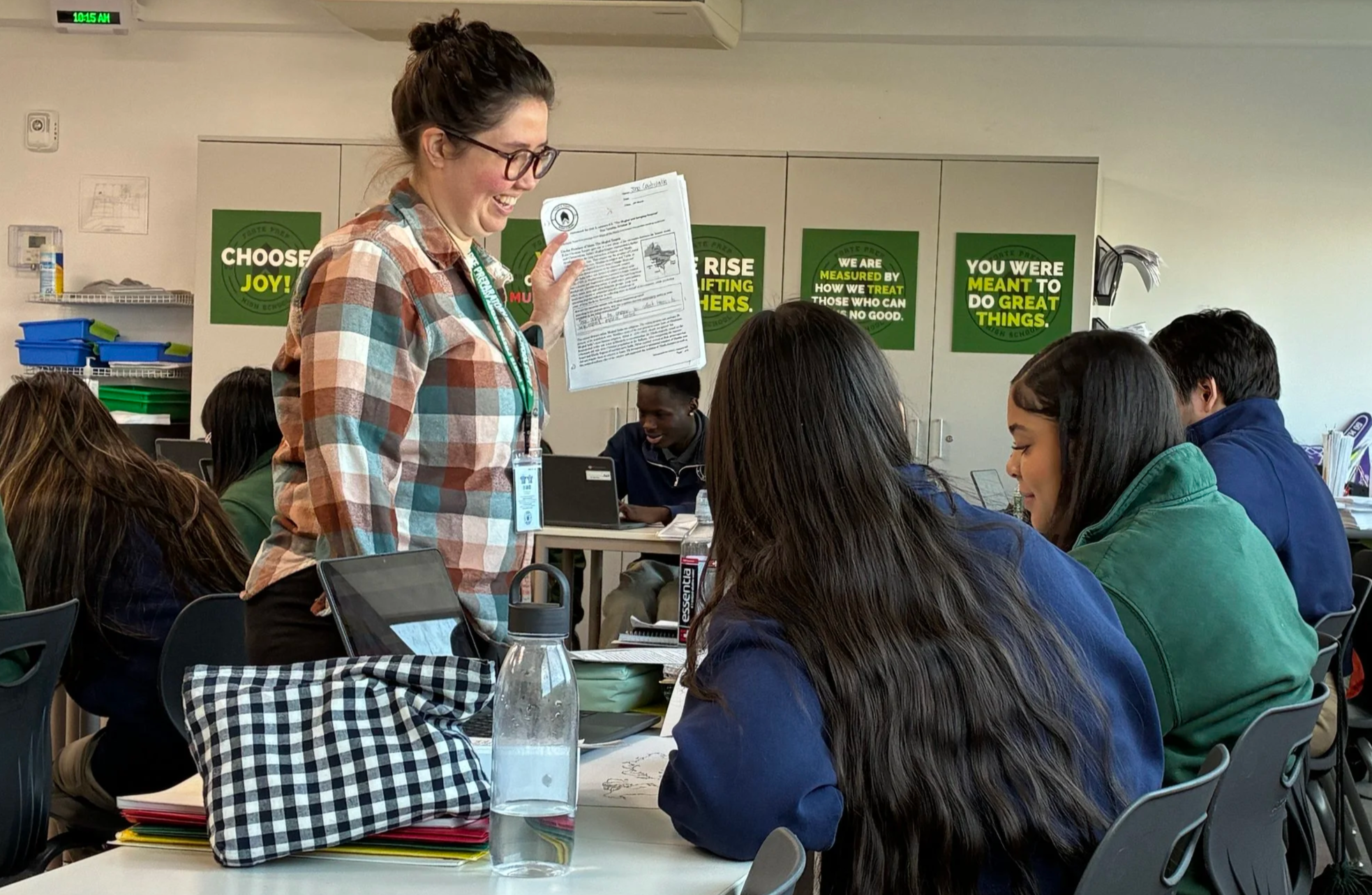
Ms. McGriff’s AP World History class, November 2026
What makes an AP class different
AP classes offer the chance to earn college credit while still in high school, and they ask more of students: a faster pace, deeper assignments, and more reading and practice done independently at home. As Sarah put it, "students in an AP class know that they have to do the reading and prep work, because the AP teacher is not going to necessarily walk through it with them in class." That independence — college-level time management and the confidence to learn on your own — is the real point. And uniquely, AP starts in 10th grade here, earlier than at many schools where you have to wait until 11th or 12th.
Getting in: grades, Regents, and a real choice
This year, students qualified for AP classes based on their grade in the previous course plus their Regents score where applicable, along with a short application — for example, an 80 in Global 1 to take AP World. That's not typical. Sarah has worked at schools that were "AP for all" and at schools that were purely AP by choice. At Forte Prep, the goal is making sure students genuinely want the challenge and aren't just signing up for every AP class on the list.
The new course selection process helps with that. Every student meets one-on-one with their advisor to build a schedule — and advisors encourage students who might be selling themselves short to pick one "reach" class, whether that’s an advanced Spanish class or AP English, while reassuring the most ambitious ones that not every class has to be an AP class this year.
New this year
Four new AP courses joined FPHS’s lineup this year: AP Seminar (a research-based English class that builds college-style independent research skills), AP Calculus, AP Statistics, and AP Business & Finance. It's a much wider array than most schools our size offer — and AP Science and AP Chinese could be on the horizon as our program keeps growing.
Support along the way
The same supports apply as in every other class: tutorial every Tuesday and Thursday from 3:40 to 4:10 — modeled on professor's office hours, where students bring a question and teachers are there to help — plus Saturday Academy.
Why it matters for college and career
Selective colleges look closely at AP coursework, and scores of 4 or 5 are a real boost to applications. AP classes also let students test-drive subjects before the stakes of college — discovering what they love (or don't) early, so they don't waste college time on the wrong path. And being a small school helps here too: teachers talk to each other and share what they know about each student, so the adults around every student can guide them.
The program ramps up over time — two AP classes in 10th grade, three in 11th, and many more for seniors — with the vision that most students will try at least one AP class before graduating.
"It's not about passing"
The biggest misconception Sarah wants students and families to reconsider: that AP is only worth it if you pass the exam. "Just being in that college-aligned environment is a good experience for students." Even a student who earns a 2 and misses the credit has still learned how to study for a college class, participate in a college-style discussion, and write a college-level paper. It's more input than output focused — the credit is great, but the experience counts either way.